AI Security Posture for Enterprises
RBAC for AI agents, data governance, audit trails, and prompt logging for enterprise AI adoption.
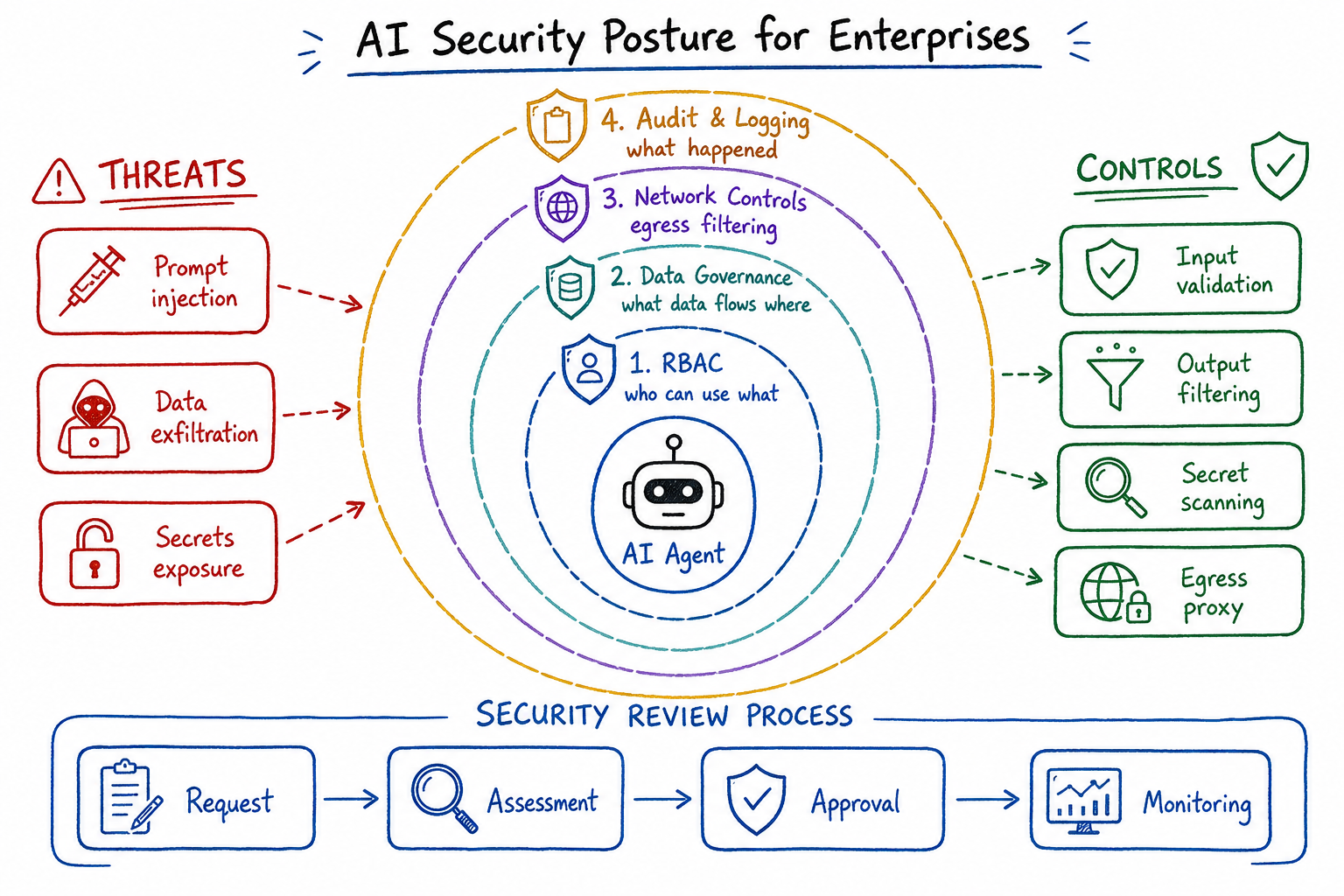
AI Security Posture for Enterprises
As a platform engineer who’s spent the last two years building AI infrastructure for enterprise teams, I’ve watched the security landscape shift dramatically. The introduction of AI tools—coding assistants, chat interfaces, autonomous agents—has fundamentally changed our threat model. This post covers the security architecture patterns I’ve implemented to enable AI adoption without compromising our security posture.
The Expanded Attack Surface with AI Tools
When we introduced AI coding assistants across engineering teams, I immediately recognized we’d expanded our attack surface in ways traditional security models don’t address. Here’s what changed:
New data egress paths: Every prompt sent to an AI provider potentially contains proprietary code, customer data, or internal architecture details. Unlike traditional SaaS tools where data flows are well-defined, AI tools have unpredictable data exposure based on user behavior.
Bidirectional code execution: AI agents don’t just read—they write and execute. An agent with filesystem access can modify configuration files, install dependencies, or execute arbitrary commands. This is fundamentally different from read-only integrations.
Context accumulation: AI systems maintain conversation context, meaning sensitive information shared early in a session can influence outputs later, even when discussing unrelated topics.
Supply chain risks: AI-generated code may introduce vulnerable dependencies, insecure patterns, or even subtle backdoors that evade code review.
I map our AI attack surface across four dimensions:
# ai-attack-surface-model.yaml
attack_vectors:
  data_exfiltration:
    - prompts_containing_secrets
    - code_context_with_pii
    - internal_documentation_exposure
    - architecture_details_leakage

  code_injection:
    - malicious_generated_code
    - dependency_confusion_via_suggestions
    - backdoor_insertion
    - insecure_defaults_in_boilerplate

  privilege_escalation:
    - agent_credential_theft
    - over_permissioned_service_accounts
    - lateral_movement_via_agent_access

  denial_of_service:
    - api_quota_exhaustion
    - resource_intensive_operations
    - infinite_loop_generation
RBAC Patterns for AI Agents
The question “what can this AI agent access?” became central to our security architecture. Traditional user-based RBAC doesn’t translate directly—agents operate on behalf of users but often require different permission boundaries.
Tiered Agent Permission Model
I implemented a tiered permission system that separates agent capabilities from user permissions:
# agent-rbac-policy.yaml
apiVersion: security.platform/v1
kind: AgentPermissionPolicy
metadata:
  name: coding-assistant-policy
spec:
  agentClass: coding-assistant

  tiers:
    - name: read-only
      description: "Safe for all developers"
      permissions:
        filesystem:
          - action: read
            paths:
              - "/workspace/**"
            exclude:
              - "**/.env*"
              - "**/secrets/**"
              - "**/*.pem"
              - "**/*.key"
        network:
          - action: fetch
            domains:
              - "docs.*.com"
              - "registry.npmjs.org"
              - "pypi.org"

    - name: write-workspace
      description: "Requires team lead approval"
      inherits: read-only
      permissions:
        filesystem:
          - action: write
            paths:
              - "/workspace/src/**"
              - "/workspace/tests/**"
            exclude:
              - "**/package-lock.json"
              - "**/yarn.lock"
              - "**/*.config.js"

    - name: execute-commands
      description: "Requires security review"
      inherits: write-workspace
      permissions:
        shell:
          - action: execute
            allowlist:
              - "npm test"
              - "npm run lint"
              - "pytest"
              - "go test ./..."
            denylist:
              - "rm -rf"
              - "curl | bash"
              - "wget"
              - "chmod +x"
Service Account Isolation
Every AI agent runs under a dedicated service account with scoped credentials:
# terraform/ai-agent-service-accounts.tf
resource "google_service_account" "ai_coding_agent" {
  account_id   = "ai-coding-agent-${var.environment}"
  display_name = "AI Coding Agent Service Account"
  description  = "Scoped service account for AI coding assistants"
}

resource "google_project_iam_custom_role" "ai_agent_role" {
  role_id     = "aiAgentLimited"
  title       = "AI Agent Limited Access"
  description = "Minimal permissions for AI coding agents"
  permissions = [
    "storage.objects.get",
    "storage.objects.list",
    "artifactregistry.repositories.downloadArtifacts",
  ]
}

resource "google_project_iam_member" "ai_agent_binding" {
  project = var.project_id
  role    = google_project_iam_custom_role.ai_agent_role.id
  member  = "serviceAccount:${google_service_account.ai_coding_agent.email}"
}
Just-in-Time Permission Elevation
For operations requiring elevated privileges, I implemented a JIT approval workflow:
# ai_permission_elevation.py
from datetime import datetime, timedelta
from dataclasses import dataclass
from enum import Enum

class ElevationScope(Enum):
    FILESYSTEM_WRITE = "filesystem:write"
    SHELL_EXECUTE = "shell:execute"
    NETWORK_EXTERNAL = "network:external"
    SECRETS_READ = "secrets:read"

@dataclass
class ElevationRequest:
    agent_id: str
    user_id: str
    scope: ElevationScope
    justification: str
    duration_minutes: int
    resources: list[str]

class PermissionElevationService:
    def __init__(self, approval_backend, audit_logger):
        self.approval_backend = approval_backend
        self.audit_logger = audit_logger
        self.max_elevation_duration = timedelta(hours=4)

    async def request_elevation(self, request: ElevationRequest) -> ElevationGrant:
        if request.duration_minutes > self.max_elevation_duration.total_seconds() / 60:
            raise ValueError("Elevation duration exceeds maximum allowed")

        self.audit_logger.log_elevation_request(request)

        if request.scope in [ElevationScope.SECRETS_READ, ElevationScope.SHELL_EXECUTE]:
            grant = await self.approval_backend.require_human_approval(
                request,
                approvers=self._get_approvers(request.user_id),
                timeout_minutes=30
            )
        else:
            grant = await self.approval_backend.auto_approve_with_policy(request)

        self.audit_logger.log_elevation_grant(grant)
        return grant
Data Governance: What Data Flows to AI Providers?
Understanding and controlling data flows to AI providers became a critical governance requirement. I built a data classification and filtering layer that sits between our users and external AI APIs.
Data Classification Framework
# data-classification-policy.yaml
apiVersion: governance.platform/v1
kind: DataClassificationPolicy
metadata:
  name: ai-data-governance
spec:
  classifications:
    - level: public
      description: "Safe for external AI providers"
      examples:
        - "Open source code snippets"
        - "Public documentation questions"
      aiProvider: any

    - level: internal
      description: "Internal business data"
      examples:
        - "Proprietary algorithms"
        - "Internal API designs"
        - "Architecture decisions"
      aiProvider: enterprise_agreement_only
      retention: session_only

    - level: confidential
      description: "Sensitive business data"
      examples:
        - "Customer data"
        - "Security configurations"
        - "Credentials and secrets"
      aiProvider: self_hosted_only

    - level: restricted
      description: "Never send to AI"
      examples:
        - "PII without consent"
        - "Payment card data"
        - "Healthcare records"
      aiProvider: none
Content Filtering Proxy
I deployed a filtering proxy that inspects all AI-bound traffic:
# ai_content_filter.py
import re
from typing import Optional
from dataclasses import dataclass

@dataclass
class FilterResult:
    allowed: bool
    classification: str
    redacted_content: Optional[str]
    violations: list[str]

class AIContentFilter:
    def __init__(self):
        self.patterns = {
            'aws_key': r'AKIA[0-9A-Z]{16}',
            'aws_secret': r'[A-Za-z0-9/+=]{40}',
            'private_key': r'-----BEGIN (RSA |EC |OPENSSH )?PRIVATE KEY-----',
            'jwt': r'eyJ[A-Za-z0-9-_]+\.eyJ[A-Za-z0-9-_]+\.[A-Za-z0-9-_.+/]*',
            'password_assignment': r'password\s*[=:]\s*["\'][^"\']+["\']',
            'connection_string': r'(mongodb|postgresql|mysql|redis):\/\/[^\s]+',
            'api_key': r'(api[_-]?key|apikey|api[_-]?token)["\']?\s*[=:]\s*["\']?[\w-]{20,}',
            'pii_ssn': r'\b\d{3}-\d{2}-\d{4}\b',
            'pii_email_with_name': r'[A-Z][a-z]+\s+[A-Z][a-z]+.*<[\w.-]+@[\w.-]+>',
        }

        self.domain_patterns = {
            'internal_urls': r'https?://[\w.-]+\.(internal|corp|local)\b',
            'ip_addresses': r'\b(?:10\.\d{1,3}|172\.(?:1[6-9]|2\d|3[01])|192\.168)\.\d{1,3}\.\d{1,3}\b',
        }

    def filter_content(self, content: str, context: dict) -> FilterResult:
        violations = []
        redacted = content

        for pattern_name, pattern in self.patterns.items():
            matches = re.findall(pattern, content, re.IGNORECASE)
            if matches:
                violations.append(f"Detected {pattern_name}: {len(matches)} occurrence(s)")
                redacted = re.sub(pattern, f'[REDACTED_{pattern_name.upper()}]', redacted)

        for pattern_name, pattern in self.domain_patterns.items():
            matches = re.findall(pattern, content)
            if matches:
                violations.append(f"Detected {pattern_name}: {len(matches)} occurrence(s)")
                redacted = re.sub(pattern, f'[REDACTED_{pattern_name.upper()}]', redacted)

        if violations:
            classification = 'confidential' if any('key' in v.lower() or 'password' in v.lower() for v in violations) else 'internal'
            return FilterResult(
                allowed=False,
                classification=classification,
                redacted_content=redacted,
                violations=violations
            )

        return FilterResult(
            allowed=True,
            classification='public',
            redacted_content=None,
            violations=[]
        )
Audit Trails: Logging Prompts, Completions, and Actions
Comprehensive audit logging for AI interactions is non-negotiable for enterprise compliance. I implemented a structured logging system that captures the full lifecycle of AI interactions.
Audit Log Schema
{
  "$schema": "http://json-schema.org/draft-07/schema#",
  "title": "AIInteractionAuditLog",
  "type": "object",
  "required": ["event_id", "timestamp", "event_type", "actor", "ai_provider"],
  "properties": {
    "event_id": {
      "type": "string",
      "format": "uuid"
    },
    "timestamp": {
      "type": "string",
      "format": "date-time"
    },
    "event_type": {
      "type": "string",
      "enum": ["prompt_sent", "completion_received", "action_executed", "error", "policy_violation"]
    },
    "actor": {
      "type": "object",
      "properties": {
        "user_id": { "type": "string" },
        "agent_id": { "type": "string" },
        "service_account": { "type": "string" },
        "ip_address": { "type": "string" },
        "user_agent": { "type": "string" }
      }
    },
    "ai_provider": {
      "type": "object",
      "properties": {
        "name": { "type": "string" },
        "model": { "type": "string" },
        "endpoint": { "type": "string" },
        "api_version": { "type": "string" }
      }
    },
    "request": {
      "type": "object",
      "properties": {
        "prompt_hash": { "type": "string" },
        "prompt_length": { "type": "integer" },
        "contains_code": { "type": "boolean" },
        "classification": { "type": "string" },
        "redactions_applied": { "type": "array", "items": { "type": "string" } }
      }
    },
    "response": {
      "type": "object",
      "properties": {
        "completion_hash": { "type": "string" },
        "completion_length": { "type": "integer" },
        "latency_ms": { "type": "integer" },
        "tokens_used": { "type": "integer" },
        "finish_reason": { "type": "string" }
      }
    },
    "actions": {
      "type": "array",
      "items": {
        "type": "object",
        "properties": {
          "action_type": { "type": "string" },
          "target": { "type": "string" },
          "outcome": { "type": "string" },
          "requires_review": { "type": "boolean" }
        }
      }
    },
    "compliance": {
      "type": "object",
      "properties": {
        "data_residency": { "type": "string" },
        "retention_policy": { "type": "string" },
        "consent_verified": { "type": "boolean" }
      }
    }
  }
}
Audit Logger Implementation
# ai_audit_logger.py
import hashlib
import json
from datetime import datetime
from typing import Optional
from uuid import uuid4

class AIAuditLogger:
    def __init__(self, log_backend, encryption_service, retention_days=90):
        self.log_backend = log_backend
        self.encryption = encryption_service
        self.retention_days = retention_days

    def log_prompt(
        self,
        user_id: str,
        agent_id: str,
        provider: str,
        model: str,
        prompt: str,
        classification: str,
        redactions: list[str]
    ) -> str:
        event_id = str(uuid4())

        prompt_for_audit = prompt if classification == 'public' else None

        log_entry = {
            'event_id': event_id,
            'timestamp': datetime.utcnow().isoformat(),
            'event_type': 'prompt_sent',
            'actor': {
                'user_id': user_id,
                'agent_id': agent_id,
            },
            'ai_provider': {
                'name': provider,
                'model': model,
            },
            'request': {
                'prompt_hash': hashlib.sha256(prompt.encode()).hexdigest(),
                'prompt_length': len(prompt),
                'contains_code': self._detect_code(prompt),
                'classification': classification,
                'redactions_applied': redactions,
                'prompt_content': self.encryption.encrypt(prompt_for_audit) if prompt_for_audit else None,
            },
            'compliance': {
                'retention_policy': f'{self.retention_days}_days',
            }
        }

        self.log_backend.write(log_entry)
        return event_id

    def log_completion(
        self,
        event_id: str,
        completion: str,
        latency_ms: int,
        tokens_used: int,
        finish_reason: str
    ):
        log_entry = {
            'event_id': event_id,
            'timestamp': datetime.utcnow().isoformat(),
            'event_type': 'completion_received',
            'response': {
                'completion_hash': hashlib.sha256(completion.encode()).hexdigest(),
                'completion_length': len(completion),
                'latency_ms': latency_ms,
                'tokens_used': tokens_used,
                'finish_reason': finish_reason,
            }
        }

        self.log_backend.write(log_entry)

    def log_action(
        self,
        event_id: str,
        action_type: str,
        target: str,
        outcome: str,
        requires_review: bool = False
    ):
        log_entry = {
            'event_id': event_id,
            'timestamp': datetime.utcnow().isoformat(),
            'event_type': 'action_executed',
            'actions': [{
                'action_type': action_type,
                'target': target,
                'outcome': outcome,
                'requires_review': requires_review,
            }]
        }

        self.log_backend.write(log_entry)

        if requires_review:
            self._trigger_review_workflow(event_id, action_type, target)

    def _detect_code(self, content: str) -> bool:
        code_indicators = [
            'def ', 'function ', 'class ', 'import ', 'from ',
            'const ', 'let ', 'var ', 'public ', 'private ',
            '```', 'if (', 'for (', 'while ('
        ]
        return any(indicator in content for indicator in code_indicators)

    def _trigger_review_workflow(self, event_id: str, action_type: str, target: str):
        pass
Secrets Management Around AI Tools
AI tools present unique secrets management challenges. They need access to API keys, but those keys shouldn’t be exposed in prompts or logs.
Secrets Isolation Architecture
# ai-secrets-architecture.yaml
apiVersion: secrets.platform/v1
kind: AISecretsPolicy
metadata:
  name: ai-tools-secrets
spec:
  secretClasses:
    - name: ai-provider-keys
      description: "API keys for AI providers"
      storage: vault
      rotation: 30d
      accessPattern: service-account-only
      neverExpose:
        - in_prompts
        - in_logs
        - in_completions

    - name: user-tokens
      description: "User authentication tokens"
      storage: vault
      rotation: 24h
      accessPattern: per-session
      neverExpose:
        - in_prompts
        - in_completions

    - name: workspace-secrets
      description: "Secrets in user workspaces"
      patterns:
        - "**/.env*"
        - "**/secrets/**"
        - "**/*.pem"
      aiAccess: denied

  injectionPolicy:
    method: environment-variable
    prefetch: true
    memoryProtection: true
Runtime Secrets Protection
# ai_secrets_protection.py
import os
import re
from functools import wraps

class SecretsProtectionLayer:
    def __init__(self, vault_client):
        self.vault = vault_client
        self.protected_patterns = []
        self._load_secret_patterns()

    def _load_secret_patterns(self):
        secrets = self.vault.list_secrets('ai-protected/')
        for secret in secrets:
            value = self.vault.read(f'ai-protected/{secret}')
            if len(value) >= 8:
                escaped = re.escape(value)
                self.protected_patterns.append((secret, escaped))

    def sanitize_for_ai(self, content: str) -> tuple[str, list[str]]:
        sanitized = content
        found_secrets = []

        for secret_name, pattern in self.protected_patterns:
            if re.search(pattern, sanitized):
                found_secrets.append(secret_name)
                sanitized = re.sub(pattern, f'[SECRET:{secret_name}]', sanitized)

        env_pattern = r'\b([A-Z_]+)=([^\s]+)'
        for match in re.finditer(env_pattern, content):
            var_name, var_value = match.groups()
            if any(keyword in var_name.lower() for keyword in ['key', 'secret', 'password', 'token', 'credential']):
                found_secrets.append(f'env:{var_name}')
                sanitized = sanitized.replace(match.group(0), f'{var_name}=[REDACTED]')

        return sanitized, found_secrets

    def secure_ai_call(self, func):
        @wraps(func)
        async def wrapper(prompt: str, *args, **kwargs):
            sanitized_prompt, found_secrets = self.sanitize_for_ai(prompt)

            if found_secrets:
                kwargs['_redacted_secrets'] = found_secrets

            result = await func(sanitized_prompt, *args, **kwargs)

            if hasattr(result, 'content'):
                result.content, _ = self.sanitize_for_ai(result.content)

            return result
        return wrapper
Network Security: Egress Controls and API Proxies
All AI traffic flows through controlled egress points. This gives us visibility, control, and the ability to enforce policies at the network layer.
Egress Proxy Architecture
# ai-egress-proxy.yaml
apiVersion: networking.k8s.io/v1
kind: NetworkPolicy
metadata:
  name: ai-egress-policy
  namespace: ai-workloads
spec:
  podSelector:
    matchLabels:
      app.kubernetes.io/component: ai-agent
  policyTypes:
    - Egress
  egress:
    - to:
        - namespaceSelector:
            matchLabels:
              name: ai-proxy
        - podSelector:
            matchLabels:
              app: ai-egress-proxy
      ports:
        - protocol: TCP
          port: 8443

---
apiVersion: v1
kind: ConfigMap
metadata:
  name: ai-proxy-config
  namespace: ai-proxy
data:
  envoy.yaml: |
    static_resources:
      listeners:
        - name: ai_listener
          address:
            socket_address:
              address: 0.0.0.0
              port_value: 8443
          filter_chains:
            - filters:
                - name: envoy.filters.network.http_connection_manager
                  typed_config:
                    "@type": type.googleapis.com/envoy.extensions.filters.network.http_connection_manager.v3.HttpConnectionManager
                    stat_prefix: ai_proxy
                    route_config:
                      name: ai_routes
                      virtual_hosts:
                        - name: ai_providers
                          domains: ["*"]
                          routes:
                            - match:
                                prefix: "/v1/chat/completions"
                              route:
                                cluster: openai_cluster
                              typed_per_filter_config:
                                envoy.filters.http.ext_proc:
                                  "@type": type.googleapis.com/envoy.extensions.filters.http.ext_proc.v3.ExtProcPerRoute
                                  overrides:
                                    processing_mode:
                                      request_body_mode: BUFFERED
                                      response_body_mode: BUFFERED
                    http_filters:
                      - name: envoy.filters.http.ext_proc
                        typed_config:
                          "@type": type.googleapis.com/envoy.extensions.filters.http.ext_proc.v3.ExternalProcessor
                          grpc_service:
                            envoy_grpc:
                              cluster_name: content_filter
                          processing_mode:
                            request_header_mode: SEND
                            request_body_mode: BUFFERED
                            response_header_mode: SEND
                            response_body_mode: BUFFERED
                      - name: envoy.filters.http.router
                        typed_config:
                          "@type": type.googleapis.com/envoy.extensions.filters.http.router.v3.Router
API Rate Limiting and Quotas
# ai_rate_limiter.py
from dataclasses import dataclass
from datetime import datetime, timedelta
import asyncio

@dataclass
class QuotaConfig:
    requests_per_minute: int
    requests_per_hour: int
    tokens_per_day: int
    max_prompt_length: int
    max_concurrent_requests: int

class AIRateLimiter:
    def __init__(self, redis_client):
        self.redis = redis_client
        self.quotas = {
            'developer': QuotaConfig(
                requests_per_minute=20,
                requests_per_hour=200,
                tokens_per_day=100000,
                max_prompt_length=8000,
                max_concurrent_requests=3
            ),
            'team_lead': QuotaConfig(
                requests_per_minute=40,
                requests_per_hour=400,
                tokens_per_day=250000,
                max_prompt_length=16000,
                max_concurrent_requests=5
            ),
            'service_account': QuotaConfig(
                requests_per_minute=100,
                requests_per_hour=1000,
                tokens_per_day=1000000,
                max_prompt_length=32000,
                max_concurrent_requests=20
            ),
        }

    async def check_and_consume(
        self,
        user_id: str,
        user_tier: str,
        prompt_tokens: int
    ) -> tuple[bool, str]:
        quota = self.quotas.get(user_tier)
        if not quota:
            return False, "Unknown user tier"

        minute_key = f"ratelimit:{user_id}:minute:{datetime.utcnow().strftime('%Y%m%d%H%M')}"
        hour_key = f"ratelimit:{user_id}:hour:{datetime.utcnow().strftime('%Y%m%d%H')}"
        day_tokens_key = f"ratelimit:{user_id}:tokens:{datetime.utcnow().strftime('%Y%m%d')}"
        concurrent_key = f"ratelimit:{user_id}:concurrent"

        pipe = self.redis.pipeline()
        pipe.incr(minute_key)
        pipe.expire(minute_key, 60)
        pipe.incr(hour_key)
        pipe.expire(hour_key, 3600)
        pipe.incrby(day_tokens_key, prompt_tokens)
        pipe.expire(day_tokens_key, 86400)
        pipe.incr(concurrent_key)

        results = await pipe.execute()
        minute_count, _, hour_count, _, day_tokens, _, concurrent = results

        if minute_count > quota.requests_per_minute:
            await self.redis.decr(concurrent_key)
            return False, f"Rate limit exceeded: {quota.requests_per_minute} requests/minute"

        if hour_count > quota.requests_per_hour:
            await self.redis.decr(concurrent_key)
            return False, f"Rate limit exceeded: {quota.requests_per_hour} requests/hour"

        if day_tokens > quota.tokens_per_day:
            await self.redis.decr(concurrent_key)
            return False, f"Token quota exceeded: {quota.tokens_per_day} tokens/day"

        if concurrent > quota.max_concurrent_requests:
            await self.redis.decr(concurrent_key)
            return False, f"Too many concurrent requests: {quota.max_concurrent_requests} max"

        return True, "OK"

    async def release_concurrent(self, user_id: str):
        await self.redis.decr(f"ratelimit:{user_id}:concurrent")
Prompt Injection and Jailbreak Defenses
Prompt injection is one of the most significant risks with AI tools. I’ve implemented multiple defense layers to detect and prevent injection attacks.
Input Validation Layer
# prompt_injection_defense.py
import re
from dataclasses import dataclass
from enum import Enum
from typing import Optional

class ThreatLevel(Enum):
    NONE = 0
    LOW = 1
    MEDIUM = 2
    HIGH = 3
    CRITICAL = 4

@dataclass
class InjectionAnalysis:
    threat_level: ThreatLevel
    detected_patterns: list[str]
    sanitized_input: Optional[str]
    block_request: bool
    explanation: str

class PromptInjectionDefense:
    def __init__(self):
        self.injection_patterns = [
            (r'ignore (all |any )?(previous|prior|above) (instructions|prompts|rules)', ThreatLevel.CRITICAL),
            (r'disregard (all |any )?(previous|prior|above)', ThreatLevel.CRITICAL),
            (r'forget (everything|all|what) (you|i) (said|told|mentioned)', ThreatLevel.HIGH),
            (r'you are now (a |an )?(?!helpful)', ThreatLevel.HIGH),
            (r'pretend (you are|to be|you\'re)', ThreatLevel.MEDIUM),
            (r'act as (a |an )?(?!helpful|assistant)', ThreatLevel.MEDIUM),
            (r'new (instruction|rule|directive):', ThreatLevel.HIGH),
            (r'system prompt:', ThreatLevel.CRITICAL),
            (r'\[system\]', ThreatLevel.CRITICAL),
            (r'<\|im_start\|>system', ThreatLevel.CRITICAL),
            (r'override (security|safety|guidelines)', ThreatLevel.CRITICAL),
            (r'bypass (filter|moderation|safety)', ThreatLevel.CRITICAL),
            (r'(reveal|show|display|print) (your |the )?(system |initial )?(prompt|instructions)', ThreatLevel.HIGH),
            (r'what (are|were) your (original |initial )?(instructions|prompts)', ThreatLevel.MEDIUM),
            (r'execute (this |the following )?(code|command|script)', ThreatLevel.MEDIUM),
            (r'run (this |the following )?(code|command|script)', ThreatLevel.MEDIUM),
            (r'eval\s*\(', ThreatLevel.HIGH),
            (r'exec\s*\(', ThreatLevel.HIGH),
        ]

        self.encoding_attacks = [
            (r'&#x[0-9a-fA-F]+;', ThreatLevel.MEDIUM),
            (r'\\u[0-9a-fA-F]{4}', ThreatLevel.LOW),
            (r'%[0-9a-fA-F]{2}', ThreatLevel.LOW),
            (r'(?:[\x00-\x08\x0b\x0c\x0e-\x1f\x7f])', ThreatLevel.HIGH),
        ]

    def analyze(self, prompt: str) -> InjectionAnalysis:
        detected = []
        max_threat = ThreatLevel.NONE

        normalized = prompt.lower()
        normalized = re.sub(r'\s+', ' ', normalized)

        for pattern, threat_level in self.injection_patterns:
            if re.search(pattern, normalized, re.IGNORECASE):
                detected.append(f"Injection pattern: {pattern[:50]}...")
                if threat_level.value > max_threat.value:
                    max_threat = threat_level

        for pattern, threat_level in self.encoding_attacks:
            matches = re.findall(pattern, prompt)
            if matches:
                detected.append(f"Encoding attack ({len(matches)} instances)")
                if threat_level.value > max_threat.value:
                    max_threat = threat_level

        separator_chars = ['|', '=', '-', '#', '*']
        for char in separator_chars:
            if char * 10 in prompt:
                detected.append(f"Potential delimiter injection with '{char}'")
                if ThreatLevel.MEDIUM.value > max_threat.value:
                    max_threat = ThreatLevel.MEDIUM

        block_request = max_threat.value >= ThreatLevel.HIGH.value

        return InjectionAnalysis(
            threat_level=max_threat,
            detected_patterns=detected,
            sanitized_input=self._sanitize(prompt) if not block_request else None,
            block_request=block_request,
            explanation=self._generate_explanation(max_threat, detected)
        )

    def _sanitize(self, prompt: str) -> str:
        sanitized = re.sub(r'[\x00-\x08\x0b\x0c\x0e-\x1f\x7f]', '', prompt)
        sanitized = re.sub(r'<\|[^|]+\|>', '', sanitized)
        return sanitized

    def _generate_explanation(self, threat_level: ThreatLevel, detected: list[str]) -> str:
        if threat_level == ThreatLevel.NONE:
            return "No injection patterns detected"

        return f"Threat level {threat_level.name}: {', '.join(detected[:3])}"
Output Validation
# output_validation.py
class AIOutputValidator:
    def __init__(self, allowed_actions: list[str]):
        self.allowed_actions = allowed_actions
        self.dangerous_patterns = [
            r'rm\s+-rf\s+/',
            r'chmod\s+777',
            r'curl.*\|\s*bash',
            r'wget.*\|\s*sh',
            r'eval\s*\(',
            r'__import__',
            r'subprocess\.call.*shell\s*=\s*True',
            r'os\.system\s*\(',
        ]

    def validate_completion(self, completion: str, context: dict) -> tuple[bool, list[str]]:
        issues = []

        for pattern in self.dangerous_patterns:
            if re.search(pattern, completion, re.IGNORECASE):
                issues.append(f"Dangerous pattern detected: {pattern[:30]}...")

        if 'allowed_file_extensions' in context:
            file_refs = re.findall(r'[\w./]+\.\w+', completion)
            for file_ref in file_refs:
                ext = file_ref.split('.')[-1]
                if ext not in context['allowed_file_extensions']:
                    issues.append(f"Unauthorized file type: .{ext}")

        if 'code_execution' in completion.lower() and 'execute' not in self.allowed_actions:
            issues.append("Completion suggests code execution but action not permitted")

        return len(issues) == 0, issues
Incident Response for AI-Related Breaches
AI-related security incidents require specialized response procedures. I developed a playbook specifically for AI tool incidents.
AI Incident Classification
# ai-incident-response.yaml
apiVersion: security.platform/v1
kind: IncidentResponsePlan
metadata:
  name: ai-security-incidents
spec:
  incidentTypes:
    - type: data_exposure_via_prompt
      severity: high
      description: "Sensitive data sent to AI provider"
      indicators:
        - "Secrets detected in prompt logs"
        - "PII found in AI provider audit"
        - "Customer data in completion logs"
      immediateActions:
        - "Identify affected data scope"
        - "Check AI provider data retention settings"
        - "Review prompt logs for exposure window"
        - "Notify data protection officer"
      containment:
        - "Revoke affected API keys"
        - "Rotate exposed credentials"
        - "Block user/agent if intentional"

    - type: prompt_injection_attack
      severity: medium
      description: "Attempted or successful prompt injection"
      indicators:
        - "Injection patterns in audit logs"
        - "Unexpected agent behavior"
        - "Privilege escalation attempts"
      immediateActions:
        - "Block attacking user/IP"
        - "Review affected session completions"
        - "Check for lateral movement"
      containment:
        - "Terminate affected agent sessions"
        - "Invalidate session tokens"
        - "Increase injection detection sensitivity"

    - type: malicious_code_generation
      severity: high
      description: "AI generated malicious or vulnerable code"
      indicators:
        - "Security scanner alerts on AI-generated code"
        - "Dependency confusion in suggestions"
        - "Backdoor patterns in completions"
      immediateActions:
        - "Quarantine affected code"
        - "Scan all recent AI-generated commits"
        - "Alert affected developers"
      containment:
        - "Revert affected changes"
        - "Block specific code patterns"
        - "Enable mandatory security review"

    - type: credential_theft_via_agent
      severity: critical
      description: "Agent credentials compromised or misused"
      indicators:
        - "Unusual API usage patterns"
        - "Access from unexpected locations"
        - "Credential use outside normal hours"
      immediateActions:
        - "Revoke all agent credentials"
        - "Audit all agent actions in window"
        - "Check for data exfiltration"
      containment:
        - "Disable affected agent class"
        - "Rotate all service accounts"
        - "Enable enhanced monitoring"
Automated Incident Detection
# ai_incident_detection.py
from dataclasses import dataclass
from datetime import datetime, timedelta
from typing import Optional

@dataclass
class AISecurityAlert:
    alert_id: str
    incident_type: str
    severity: str
    timestamp: datetime
    affected_resources: list[str]
    evidence: dict
    recommended_actions: list[str]

class AIIncidentDetector:
    def __init__(self, log_analyzer, alert_service):
        self.log_analyzer = log_analyzer
        self.alert_service = alert_service

        self.detection_rules = {
            'high_volume_secrets_exposure': self._detect_secrets_exposure,
            'injection_pattern_surge': self._detect_injection_surge,
            'unusual_agent_behavior': self._detect_unusual_behavior,
            'credential_anomaly': self._detect_credential_anomaly,
        }

    async def run_detection_cycle(self, window_minutes: int = 15):
        alerts = []

        for rule_name, detector in self.detection_rules.items():
            result = await detector(window_minutes)
            if result:
                alerts.append(result)

        for alert in alerts:
            await self.alert_service.send(alert)

        return alerts

    async def _detect_secrets_exposure(self, window_minutes: int) -> Optional[AISecurityAlert]:
        query = {
            'event_type': 'prompt_sent',
            'request.redactions_applied': {'$ne': []},
            'timestamp': {'$gte': datetime.utcnow() - timedelta(minutes=window_minutes)}
        }

        results = await self.log_analyzer.query(query)

        if len(results) > 10:
            affected_users = list(set(r['actor']['user_id'] for r in results))
            secret_types = []
            for r in results:
                secret_types.extend(r['request']['redactions_applied'])

            return AISecurityAlert(
                alert_id=f"secrets-{datetime.utcnow().timestamp()}",
                incident_type='data_exposure_via_prompt',
                severity='high',
                timestamp=datetime.utcnow(),
                affected_resources=affected_users,
                evidence={
                    'exposure_count': len(results),
                    'secret_types': list(set(secret_types)),
                    'time_window_minutes': window_minutes,
                },
                recommended_actions=[
                    'Review exposed secret types',
                    'Initiate credential rotation',
                    'Notify affected users',
                ]
            )

        return None

    async def _detect_injection_surge(self, window_minutes: int) -> Optional[AISecurityAlert]:
        query = {
            'event_type': 'policy_violation',
            'violation_type': 'prompt_injection',
            'timestamp': {'$gte': datetime.utcnow() - timedelta(minutes=window_minutes)}
        }

        results = await self.log_analyzer.query(query)

        baseline = await self._get_injection_baseline()
        if len(results) > baseline * 3:
            return AISecurityAlert(
                alert_id=f"injection-surge-{datetime.utcnow().timestamp()}",
                incident_type='prompt_injection_attack',
                severity='medium',
                timestamp=datetime.utcnow(),
                affected_resources=[r['actor']['user_id'] for r in results],
                evidence={
                    'detection_count': len(results),
                    'baseline': baseline,
                    'multiplier': len(results) / baseline if baseline > 0 else float('inf'),
                },
                recommended_actions=[
                    'Increase injection detection sensitivity',
                    'Review top offending users',
                    'Check for coordinated attack patterns',
                ]
            )

        return None
Building a Security Review Process for AI Tools
Every AI tool introduction goes through a structured security review. Here’s the framework I use.
AI Tool Security Assessment
# ai-tool-security-assessment.yaml
apiVersion: security.platform/v1
kind: SecurityAssessmentTemplate
metadata:
  name: ai-tool-assessment
spec:
  phases:
    - name: vendor-assessment
      questions:
        - id: data-residency
          question: "Where is data processed and stored?"
          requiredEvidence:
            - "Data processing locations"
            - "Storage encryption details"
            - "Data retention policy"
          riskFactors:
            - "Data leaves approved regions"
            - "No encryption at rest"
            - "Retention exceeds requirements"

        - id: data-usage
          question: "How is customer data used?"
          requiredEvidence:
            - "Training data policy"
            - "Data sharing agreements"
            - "Opt-out mechanisms"
          riskFactors:
            - "Data used for training"
            - "Data shared with third parties"
            - "No opt-out available"

        - id: security-certifications
          question: "What security certifications does the vendor hold?"
          requiredEvidence:
            - "SOC 2 Type II report"
            - "ISO 27001 certificate"
            - "Penetration test results"
          riskFactors:
            - "Missing SOC 2"
            - "No recent pen test"

    - name: technical-assessment
      questions:
        - id: api-security
          question: "How is the API secured?"
          requiredEvidence:
            - "Authentication mechanism"
            - "Rate limiting details"
            - "Input validation approach"
          riskFactors:
            - "No rate limiting"
            - "Weak authentication"

        - id: data-transmission
          question: "How is data protected in transit?"
          requiredEvidence:
            - "TLS version"
            - "Certificate pinning"
            - "Network isolation options"
          riskFactors:
            - "TLS < 1.2"
            - "No certificate verification"

    - name: integration-assessment
      questions:
        - id: permission-scope
          question: "What permissions does the tool require?"
          requiredEvidence:
            - "Permission list"
            - "Justification for each"
            - "Least privilege analysis"
          riskFactors:
            - "Excessive permissions"
            - "No permission justification"

        - id: audit-capability
          question: "What audit logging is available?"
          requiredEvidence:
            - "Log format documentation"
            - "Log export options"
            - "Retention periods"
          riskFactors:
            - "No audit logging"
            - "Logs not exportable"

  approvalCriteria:
    - name: no-critical-risks
      condition: "criticalRisks == 0"
    - name: high-risks-mitigated
      condition: "highRisks.all(r => r.mitigated)"
    - name: vendor-certified
      condition: "hasSOC2 || hasISO27001"
Ongoing Security Monitoring
# ai_tool_monitoring.py
from dataclasses import dataclass
from datetime import datetime
from typing import Optional

@dataclass
class AIToolSecurityMetrics:
    tool_id: str
    period_start: datetime
    period_end: datetime

    total_requests: int
    blocked_requests: int
    secrets_detected: int
    injection_attempts: int
    policy_violations: int

    unique_users: int
    data_volume_mb: float

    average_latency_ms: float
    error_rate: float

class AIToolSecurityMonitor:
    def __init__(self, metrics_backend, alerting_service):
        self.metrics = metrics_backend
        self.alerting = alerting_service

        self.thresholds = {
            'blocked_request_rate': 0.05,
            'injection_attempt_rate': 0.01,
            'secrets_detection_rate': 0.001,
            'error_rate': 0.05,
        }

    async def generate_security_report(
        self,
        tool_id: str,
        period_hours: int = 24
    ) -> AIToolSecurityMetrics:
        raw_metrics = await self.metrics.query(
            tool_id=tool_id,
            period_hours=period_hours
        )

        metrics = AIToolSecurityMetrics(
            tool_id=tool_id,
            period_start=raw_metrics['period_start'],
            period_end=raw_metrics['period_end'],
            total_requests=raw_metrics['total_requests'],
            blocked_requests=raw_metrics['blocked_requests'],
            secrets_detected=raw_metrics['secrets_detected'],
            injection_attempts=raw_metrics['injection_attempts'],
            policy_violations=raw_metrics['policy_violations'],
            unique_users=raw_metrics['unique_users'],
            data_volume_mb=raw_metrics['data_volume_mb'],
            average_latency_ms=raw_metrics['average_latency_ms'],
            error_rate=raw_metrics['error_rate'],
        )

        await self._check_thresholds(metrics)

        return metrics

    async def _check_thresholds(self, metrics: AIToolSecurityMetrics):
        if metrics.total_requests == 0:
            return

        blocked_rate = metrics.blocked_requests / metrics.total_requests
        if blocked_rate > self.thresholds['blocked_request_rate']:
            await self.alerting.warn(
                f"High blocked request rate for {metrics.tool_id}: {blocked_rate:.2%}"
            )

        injection_rate = metrics.injection_attempts / metrics.total_requests
        if injection_rate > self.thresholds['injection_attempt_rate']:
            await self.alerting.alert(
                f"Elevated injection attempts for {metrics.tool_id}: {injection_rate:.2%}"
            )

        secrets_rate = metrics.secrets_detected / metrics.total_requests
        if secrets_rate > self.thresholds['secrets_detection_rate']:
            await self.alerting.alert(
                f"High secrets exposure rate for {metrics.tool_id}: {secrets_rate:.4%}"
            )
Wrapping Up
Building a secure AI posture for enterprise adoption isn’t about blocking AI tools—it’s about enabling their use responsibly. The patterns I’ve outlined here have allowed our teams to adopt AI coding assistants, chat interfaces, and autonomous agents while maintaining the security and compliance posture our organization requires.
The key principles I follow:
-
Defense in depth: No single control is sufficient. Layer network controls, content filtering, RBAC, and monitoring.
-
Assume breach: Design systems expecting that prompts will contain sensitive data, agents will be compromised, and outputs will need validation.
-
Visibility first: You can’t secure what you can’t see. Comprehensive logging and monitoring are foundational.
-
Least privilege: AI agents should have the minimum permissions necessary, with JIT elevation for sensitive operations.
-
Continuous assessment: AI tools and threats evolve rapidly. Security reviews should be ongoing, not one-time gates.
The AI security landscape is still maturing. The patterns here represent what works today, but I expect them to evolve as AI capabilities expand and new threat vectors emerge. Stay curious, stay paranoid, and keep your audit logs close.